



Quadruped Robots for Inspection, Security & Farming
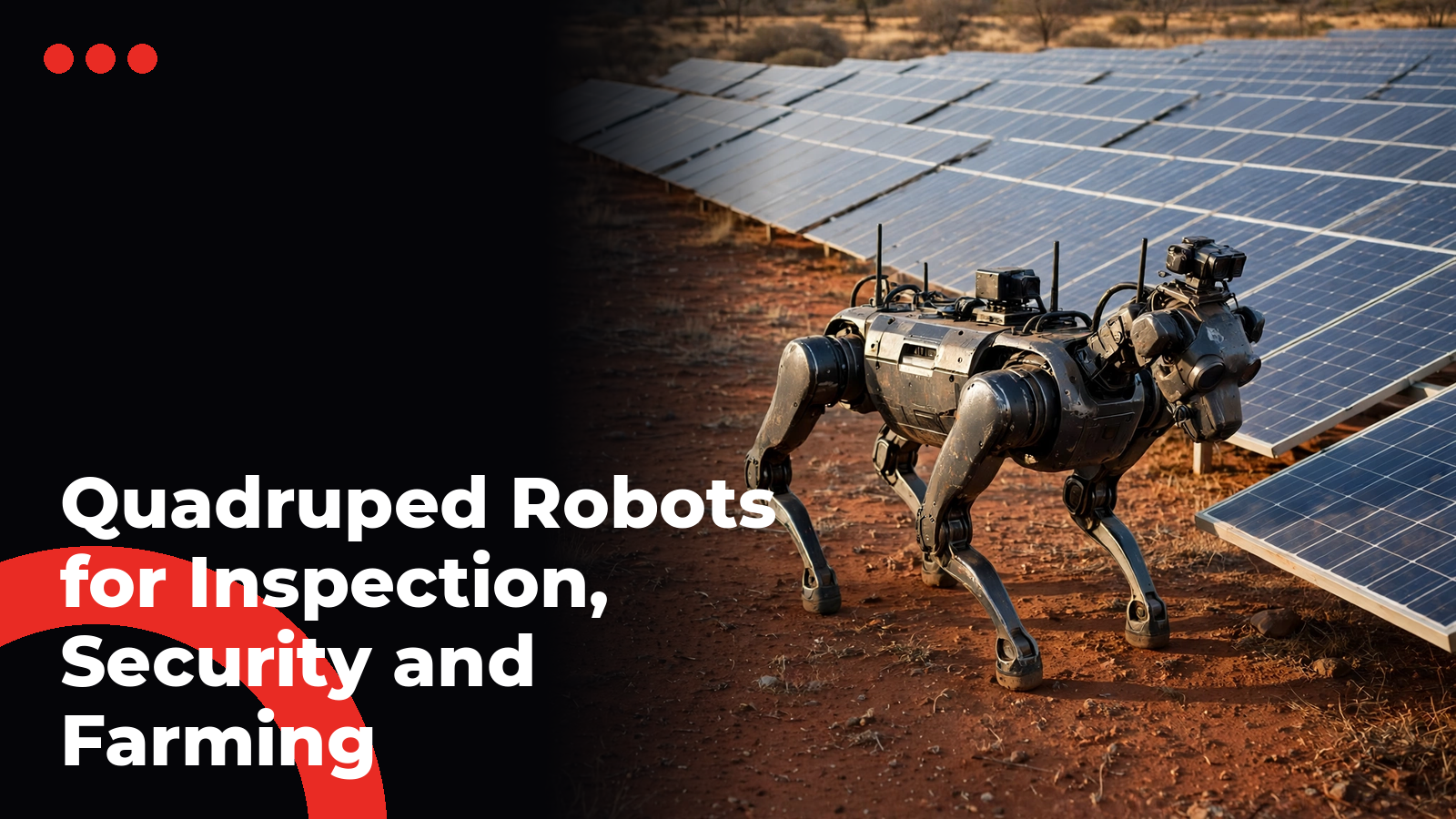
If you manage a site, a farm, or a facility in Australia, you know the problem. The places you most need to check are often the hardest to get to. Rough tracks, stairs, muddy yards, plant rooms, and fence lines that eat up staff time. That is where quadruped robots for inspection are earning attention. A four legged robot can step over obstacles, climb stairs, and keep moving on ground that would stop a wheeled machine, while carrying cameras and sensors to do the looking for you.
Australian buyers can order real machines today, from a compact Go2 to a full industrial B2 Inspection Robot. Picking the right one comes down to the job, the terrain, and how much weight the robot needs to carry.
Why Quadruped Robots Beat Wheels for Inspection, Security and Farming
A quadruped robot beats wheels on broken ground because legs can step over, step up, and step around obstacles instead of needing a smooth, continuous path. A wheel needs a road. A leg needs a foothold. On a rutted farm track, in a plant room with cables, or on a site with rubble and stairs, that difference decides whether the robot finishes the route.
Balance is the second reason. A quadruped constantly adjusts its weight over its planted feet, so it handles slopes, gravel, and short grass far better than a small wheeled platform. That matters for a quadruped robot for inspection, where the point is to look at something in a place that is awkward to reach repeatedly. Think under conveyors, around storage tanks, or up industrial stairs to check a gauge.
The third reason is payload. Legs lift the body clear of the ground, leaving room for cameras, LiDAR, and thermal sensors. Instead of sending a person with a torch at 2 am, you can send the robot along a set route and review the data back in the office.
Wheels still win on flat warehouse floors, and the A2-W covered later mixes both ideas. Walk your route and count the curbs, stairs, and rough patches. If the list is long, legs make sense. There is a safety angle too. Sending a robot into a hot, noisy, or restricted area for a first look can keep a person out of harm, and it gives a qualified inspector better information, earlier, with less risk.
Inspection: Which Quadruped for Industrial Sites, Mines and Infrastructure?
The best quadruped robot for industrial inspection is the one that matches your site size, terrain, and sensor load, and for heavy industrial work in Australia that usually points to the B2 class of machine. For a large site with rough ground and serious gear on board, the Unitree B2 Inspection Robot is built for that job. Smaller sites may not need that level at all.
How much does a Unitree B2 inspection robot cost? At E-Ozzie, the B2 Inspection Robot is listed on the product page — check it for the current price. You are paying for a large industrial platform, strong legs for rough terrain, room and power for serious sensors including the navigation and LiDAR setup in its name, and development access to build inspection routines. It is a capital purchase, closer to buying a vehicle than a gadget.
There is a step below that build. The Unitree B2 Robotic Quadruped with 32-Line LiDAR gives you the B2 platform with 32 line LiDAR for less.
Mining is a natural fit, and quadruped robot for mining inspection Australia is a search we expect to keep growing. Mines have uneven ground, stairs and platforms, restricted areas, and long distances between points that need a regular visual check. A quadruped can carry cameras and thermal sensing to record an area shift after shift, in the same way, without getting tired. Infrastructure is similar. Water plants, power stations, and large warehouses all have repeat routes that are dull, dirty, or spread out, and a robot doing the same route the same way creates a record you can compare week to week.
Security: Can a Robot Dog Patrol a Property or Site?
Yes, a robot dog can do security patrols along a set route, using its cameras and sensors to record what it sees and alert operators to movement. It can patrol. It cannot guard in the human sense. It will not challenge an intruder or physically stop anyone. Think of it as a mobile camera platform with legs, not a guard with fur.
That role is still very useful. A patrol robot can cover a warehouse perimeter, a car yard, or a construction site on a repeat route, at hours when you would rather not roster a person to walk the same fence line again.
For smaller sites and pilots, the Unitree Go2 Robotic Quadruped is where many Australian businesses start.
For larger, flatter sites where the route is long, the Unitree A2-W Wheeled Quadruped Robot rolls efficiently on smooth ground and can use its legs for curbs and obstacles. That mix suits a big logistics yard or a factory with long concrete runs.
Farming: Crop Scouting, Livestock Monitoring and Rough-Terrain Work
Yes, quadruped robots can be used for farm inspection in Australia, for tasks like walking crop rows, checking fence lines and troughs, and carrying cameras to scout rough ground that is slow to cover on foot. Farms were never built for smooth wheels, which makes them a natural home for legs.
Picture a typical week. Checking a trough in a far paddock, walking a fence after a storm, and looking at a crop block in a boggy spot are each simple jobs. Together they eat hours, on ground that is rough on ankles and tyres alike. A quadruped walking that route with a camera gives you eyes on the problem before the ute, the tools, or the vet needs to go out.
Crop scouting is a good starting use. The robot records consistent images at the same points over time, so poor growth, pest pressure, or irrigation problems stand out earlier. It will not replace an agronomist. It can tell that agronomist where to walk first.
Livestock monitoring is the other use people ask about, often as robot dog for livestock monitoring Australia. A quadruped moving calmly around a yard can help you check animals, gates, and water points. Introduce it gradually, as some stock will be spooked at first.
Which model fits a farm? For many, the sensible start is the Go2 for yards, sheds, and shorter routes. For larger properties with rougher routes and heavier sensors, the A2 or the A2-W is a more realistic platform. Very few farms will need a B2. Heat, dust, and mud are the honest challenges, so plan for shade and indoor storage.
The Line-Up Compared: Go2 vs A2-W vs B2 Inspection
The difference between the Unitree A2-W and B2 is scale and purpose. The A2-W is a wheeled quadruped built for long, mostly flat routes, with legs for curbs and obstacles. The B2 is a larger, heavy duty inspection platform built for rough terrain and serious sensor payloads. The Go2 sits below both as the compact way to pilot the idea.
Model |
Best suited to |
Ground it likes |
|---|---|---|
Unitree Go2 Robotic Quadruped |
Pilots, small sites, farm yards, short routes |
Flat to moderate surfaces and stairs |
Unitree A2 Quadruped Robot |
Professional field work, larger facilities |
Mixed and rougher ground |
Unitree A2-W Wheeled Quadruped Robot |
Long security and inspection routes |
Mostly flat with curbs and obstacles |
Unitree B2 Robotic Quadruped with 32-Line LiDAR |
Industrial inspection with LiDAR |
Rough industrial terrain |
Unitree B2 Inspection Robot |
Mines and major infrastructure |
Rough sites, heavy sensor loads |
Read that table from your site backwards. If your route is a small warehouse or a farm yard, the Go2 is not the cheap option. It is the right sized option. If your route is kilometres of concrete, the A2-W starts to look clever. If your route is a mine or a major plant, the B2 is priced like the industrial plant it is. Payload and sensors drive a lot of this gap, because thermal cameras, larger LiDAR, and extra computing add weight, power draw, and cost.
What to Check Before Buying: Payload, Battery, Sensors and Australian Support
Before you buy any industrial quadruped robot in Australia, check four things in writing. Payload, battery, sensors, and local support.
Payload first. List every sensor you want the robot to carry, get the weights, and leave headroom. A robot working at its limit will be slower and quicker to drain its battery.
Battery second. Ask how long the robot runs doing your kind of work, not a gentle test walk. Ask how long a charge takes, whether batteries can be swapped, and what a spare costs. Then plan your route around the real answer.
Sensors third. A visual check needs a good camera and lighting. A heat check needs a thermal camera. Navigation in a complex plant needs LiDAR. Do not pay for sensors you will never review, and do not skip one your whole inspection depends on.
Australian support is the fourth check, and at these prices it may be the most important. Who services it? Where do parts come from, and how long do they take? Buying through an Australian retailer like E-Ozzie, with stores you can visit, makes those questions easier to ask. Also ask about training, and name one person who will own the robot day to day.
Which Quadruped Should You Choose? (Decision Guide by Use Case)
Choose by use case, not by excitement. The robot that impresses you most in a video is rarely the robot your site needs.
If you are testing the idea, start with the Go2. Small businesses, farms wanting yard checks, and any team running a first pilot will learn the most per dollar here, and a pilot that teaches you your site is not ready is still money well spent.
If you need to cover distance on a large, mostly flat site, choose the A2-W. Logistics yards, factories, and campuses fit this pattern. If your ground is rougher, the standard Unitree A2 Quadruped Robot is the one to compare. It also suits larger facilities and research groups doing field work.
If you are building a serious industrial inspection program, choose the B2. Mines, power and water infrastructure, and major plants are B2 territory. Compare the B2 with 32-Line LiDAR against the full B2 Inspection Robot with your sensor list in hand.
Start with one route and one clear job. Prove it for a month, then expand. Quadruped robots for inspection, security, and farming are not magic. They are tools that, in the right place, save time, improve records, and keep people out of the worst jobs.
FAQs
What are quadruped robots used for in industry?
In industry, quadruped robots are used for visual and thermal inspection, security patrols, and data collection on sites that are rough, spread out, or restricted. They carry cameras, LiDAR, and other sensors along repeat routes in mines, power stations, factories, and warehouses.
Can robots inspect farms?
Yes. A quadruped robot can walk crop rows, check fence lines, troughs, and gates, and record images that help a farmer decide where to go and what to fix first. It works best as a scouting tool that supports the farmer, not as a replacement.
How much does an inspection robot cost?
It depends on robot size and sensors. At E-Ozzie, a Unitree Go2, an A2-W and a B2 Inspection Robot cover the range. The A2 and the B2 with 32-Line LiDAR sit between those points.
Are quadruped robots used in mining in Australia?
Yes, quadrupeds suit mining well because mines have uneven ground, stairs and platforms, and restricted areas that need regular visual checks. A robot can carry cameras and thermal sensors to record plant and infrastructure consistently across shifts. Any deployment still needs site approval and trained operators.
Can a quadruped robot work on rough terrain?
Yes, that is one of the main reasons to choose legs over wheels. A quadruped can step over obstacles, handle gravel, dirt tracks, slopes, and stairs, and keep its balance on uneven ground. Deep mud, loose sand, and flooded or very slippery ground can still stop it, so routes should be tested first.
Ready to work out which quadruped fits your site? Shop the range at eozzie.com.au and visit E-Ozzie stores in Sydney, Melbourne and Perth to talk through your route, sensors, and budget with the team.


Leave a comment