



What Is a Quadruped Robot? Unitree Go2 Explained
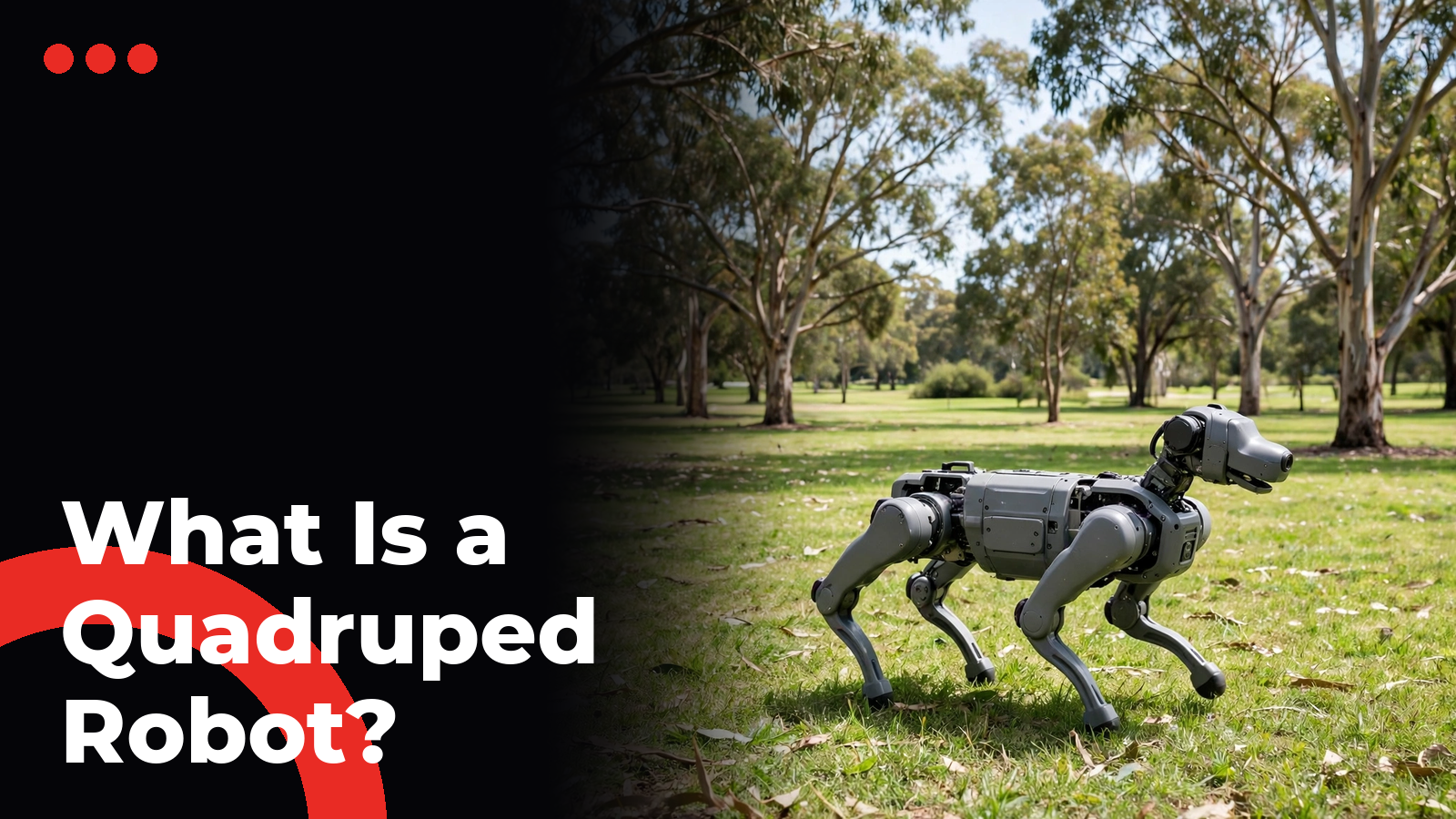
So, what is a quadruped robot, really? It is a robot that walks on four legs instead of rolling on wheels or tracks. Four legs let it step over things, climb stairs in many cases, keep its balance on uneven ground, and go places that would stop a wheeled robot cold. People often call them robot dogs, because the shape reminds them of a dog, even though most are built for work and learning, not for playing fetch.
This article uses the Unitree Go2 as the main example because it is the quadruped most Australian buyers can actually afford and order today.
What Is a Quadruped Robot? (Simple Definition)
A quadruped robot is a machine with four legs that it uses to walk, turn, and balance. Each leg has joints, a bit like a knee and an ankle, and motors that move those joints in a coordinated pattern. A computer tells the legs when to lift, swing, and plant, many times a second, so the body stays level while the feet find the ground.
That is the quadruped robot explained in one paragraph. It helps to compare it to things you know. A wheeled robot is great on flat floors. It is fast, simple, and efficient. But a wheel needs a continuous surface. A curb, a set of stairs, a pile of rubble, or a muddy track breaks the deal. Legs do not need a continuous surface. They need a series of footholds. That is why legs win on broken ground.
People also search for what is a robot dog. Usually they mean the same thing. Robot dog is the friendly nickname. Quadruped robot is the proper term on product pages and in research papers. The Go2 is sold as a quadruped, even though almost everyone who sees one in a shopping centre will point and say robot dog.
Not all quadrupeds are the same size. Some are small learning platforms you can carry in a backpack. Some are large industrial machines built to patrol a mine or a power station. The Go2 sits at the accessible end of that range.
A few traits show up in almost every quadruped:
- Four legs with powered joints that can bend and push.
- A body that carries the battery, computer, and sensors.
- A way to sense the ground and the space ahead, often cameras and LiDAR.
- Software that keeps the robot upright and plans each step.
How Does a Quadruped Robot Walk? Legs, Balance and LiDAR
A quadruped robot walks by lifting one leg at a time, or two legs in a diagonal pair, while the other legs stay planted to hold it up. The control system constantly shifts the body weight over the planted feet so the robot does not tip over. In practice it is a constant stream of small corrections, and it is the reason these robots look so alive when they move.
Think about how a dog trots. Diagonal legs move together. The body bobs a little. The head stays fairly steady. A quadruped robot copies that pattern with motors and maths. Sensors in the joints report back how much force each leg is feeling. If a foot lands on a rock and sits higher than expected, the system adjusts. If a foot slips, it adjusts again.
So how does a quadruped robot walk on ground that is not flat? Slowly at first, and with a lot of sensing. Cameras look at the surface. LiDAR builds a 3D picture of the space by bouncing light off objects and measuring how long it takes to return. On the Go2, that LiDAR helps the robot map its surroundings, avoid obstacles, and follow a person or a path with more confidence than cameras alone could give it.
Can a quadruped robot climb stairs? Yes, many can, including the Go2 on standard stairs in the right conditions. It steps up one stair at a time, placing each foot carefully and shifting its weight as it goes. It is not fast, and very steep, narrow, wet, or cluttered stairs can still beat it. But for typical household or office stairs, a quadruped can do what no wheeled robot of similar size can do.
Balance is the other party trick. Give a wheeled robot a push and it rolls. Give a quadruped a gentle shove and it will often take a quick step sideways to catch itself, just like an animal would. A hard push, a slippery floor, or a leg caught on furniture can still bring it down, so supervision is still smart.
Terrain matters too. Short grass, gravel paths, dirt tracks, and uneven paving are surfaces where legs earn their keep. Deep mud, loose sand, and polished wet tiles are harder.
Meet the Unitree Go2: Price, Specs and Versions (Air / Pro / EDU)
The Unitree Go2 is the main model listed at E-Ozzie in Australia. That is the direct answer to how much a Go2 costs here, and it is the figure that makes people sit up. A few years ago, a capable quadruped cost many times that amount. The Unitree Go2 Robotic Quadruped is within reach for schools, keen hobbyists, content creators, and small businesses testing ideas.
The Go2 is the model most people picture when they search for Unitree Go2 price Australia or Unitree Go2 specs. It is a compact quadruped with four powered legs, built in sensors, and that LiDAR unit on the front. It can walk, trot, climb over small obstacles, follow a person, and be controlled with a remote or through its app and development tools, depending on the version. Battery life and range depend on how hard you work it. Flat ground at a steady pace is gentle. Climbing and back to back demos will use the charge faster. Plan for sessions, not a full day of non stop work.
The Go2 comes in Air, Pro and EDU versions. As a general guide, the Air is the entry point, the Pro adds more sensing and interaction features for everyday users, and the EDU is aimed at schools, universities, and developers who want deeper access to program the robot themselves. Exact inclusions can vary by listing, so check the current product page before you buy. Paying for EDU access you never use is a waste. Buying an Air for a coding class that needs development access is a bigger waste.
Is the Unitree Go2 a toy or a real robot? It is a real robot that also happens to be fun. Kids love it. Adults film it. But underneath is a proper walking platform with sensors, motors, and software you can learn from and build on.
For accessories, browse the Quadruped collection (Go2 accessories, batteries, remote). Buying locally also helps with warranty questions and spare parts.
What Can the Go2 Actually Do, and What It Can't
The Unitree Go2 is used for learning robotics, exploring with a camera, following and interaction demos, light inspection tasks, and as a development platform for students and hobbyists. That is the main answer to what is the Unitree Go2 used for, and people find new uses for it every month.
In a school, a Go2 can anchor a term of STEM work. Students study how it walks, code simple behaviours, test it on different surfaces, and present what they learned. At home, a hobbyist might film creative content or enjoy watching a machine solve the small problem of crossing the backyard without face planting. In a small business, it might attract attention at an expo or test a simple patrol or inspection route.
It can follow a person, avoid many obstacles, carry out programmed movements, and give you a live view from its cameras. It can handle everyday surfaces and tackle standard stairs. For a robot at this price, that is a lot.
Now the can't list. The Go2 can't do heavy work. It is not built to carry heavy loads, pull a cart, or push through thick scrub for hours. It can't work all day on one charge. It can't be left alone to patrol a large property and make decisions for you. It can't handle being dropped, soaked, or left in a hot car in a Queensland summer. And it can't replace a well trained dog. No cuddles. Just very good maths.
Weather deserves a mention for Australian buyers. Dust, heat, and sudden downpours are part of life here. Use the Go2 in fair conditions, keep it dry, and store it indoors. If you need a robot that works in heavy rain and rough industrial sites day after day, you are looking at bigger industrial quadrupeds, with a budget to match.
Go2 vs Bigger Quadrupeds: When to Step Up to A2 or B2
The Go2 is the starting point, not the end of the range. If you outgrow it, the next step is a bigger quadruped built for heavier work, longer sessions, and rougher ground. The clearest example at E-Ozzie is the Unitree A2 Quadruped Robot. That is a very different machine at a very different price, aimed at industrial and professional users.
When do you step up? Think about payload, terrain, and duty cycle. If you need heavier sensors, rough sites, or longer and harder work than a compact robot can manage, the bigger platform earns its price. If you need learning, demos, and light tasks on everyday surfaces, the Go2 will do the job for a fraction of the cost.
Not sure which end fits you? Write down your top three tasks. Walk the school grounds and film it. Patrol a warehouse aisle. Carry a heavy thermal camera over a rough mine site. The first two point to a Go2. The third points up the range.
Should You Buy a Go2 in Australia? Who It's For
You should consider a Go2 if you are a teacher building a robotics program, a student or hobbyist who wants a real walking robot to learn on, a content creator, or a small business that wants to test quadruped ideas without spending industrial money. For them, the is the Unitree Go2 worth it question comes down to use. Used weekly, it earns its keep in learning and attention. Used twice and put in a cupboard, no robot is worth it.
For families, be clear eyed. The Go2 is a wonderful project for a tech loving household, especially for older kids and teens who will actually program it. It is not a pet, and younger kids will need close supervision while it is moving.
For businesses, think of the Go2 as a pilot. Test a patrol route. Test a demo. A successful pilot teaches you more than a year of meetings about robots, and if the job grows, you can step up with real data behind the decision.
FAQs
What is a quadruped robot?
A quadruped robot is a robot that walks on four legs instead of using wheels. Motors and sensors in each leg let it balance, step over obstacles, and move across uneven ground. The Unitree Go2 is a popular example that many people also call a robot dog.
What are quadruped robots used for?
They are used for education, research, inspection, security patrols, and exploration of places that are hard for wheeled robots to reach. Smaller models like the Go2 are used in schools and by hobbyists for learning and demos. Larger models work on industrial sites, farms, and infrastructure.
How much does a quadruped robot cost?
Prices vary a lot by size and capability. A Unitree Go2 is available in Australia at E-Ozzie, while a larger Unitree A2 costs more. Industrial models cost more again. Accessories, extra batteries, and the version you choose will also affect the final price.
Can quadruped robots climb stairs?
Yes, many quadruped robots can climb standard stairs by placing each foot carefully and shifting their weight as they go. The Go2 can handle typical household and office stairs in good conditions. Very steep, wet, narrow, or cluttered stairs can still be a challenge, so supervision is a good idea.
What is the difference between Go2 Air, Pro and EDU?
The Air is the entry level version, the Pro adds more features for everyday users, and the EDU is aimed at education and developers who need deeper programming access. The right choice depends on whether you mainly want to use the robot, or build and code your own behaviours for it. Check the current listing for exact inclusions before you buy.
Ready to meet a quadruped in person? Shop the range at eozzie.com.au and visit E-Ozzie stores in Sydney, Melbourne and Perth to see the Go2 up close and work out which version fits your school, your project, or your business.


Leave a comment