



Best Electric Bikes for Sydney Hills and Hilly Roads
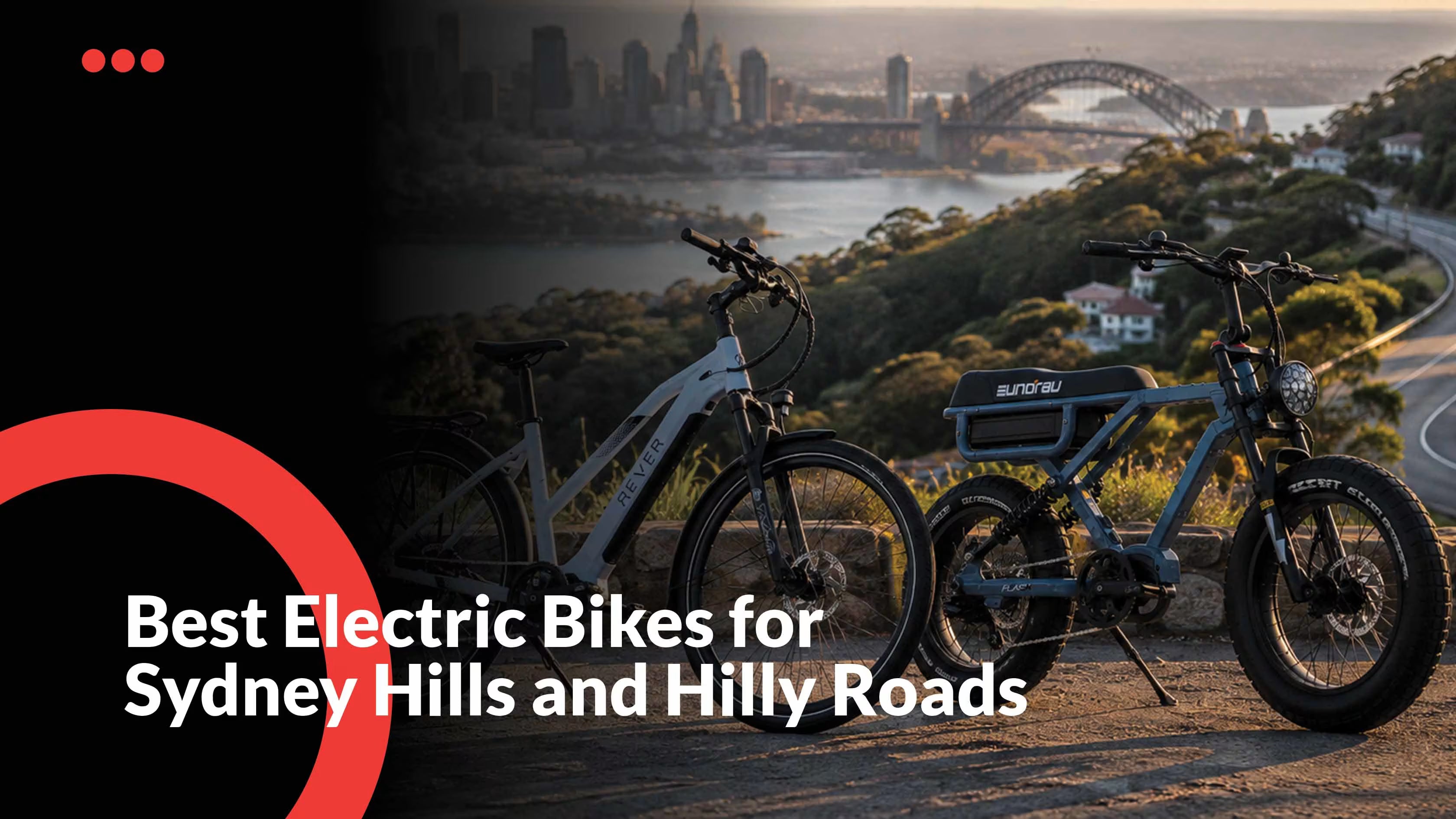
Sydney can turn a short ride into a proper workout. A route that looks easy on the map can include a sharp climb, a rough descent, a few traffic lights, and then another hill before you are home.
That is why the best electric bikes for Sydney hills are not simply the bikes with the biggest motors. For everyday riding, you want a bike that climbs smoothly, gives you useful low gears, stops confidently on the way back down and still feels manageable in traffic.
If you are comparing electric bikes for hilly roads, pay attention to the whole setup: motor position, torque, gearing, battery size, brakes, suspension, tyres and bike weight. Sydney weather matters too. Wet roads can make braking and grip just as important as climbing power.
What Type of E-Bike Is Best for Sydney Hills?
For most Sydney riders, the best e-bike for hills should include these essential features:
|
Feature |
Why it matters |
|
Road-legal 250W motor |
Future-ready for NSW’s 1 March 2029 rules. |
|
Mid-drive motor |
Uses the bike’s gears for better climbing. |
|
80–110Nm torque |
Handles steep hills, starts and heavier loads. |
|
Wide gear range |
Low gears make climbs easier. |
|
Hydraulic disc brakes |
Improve control on steep or wet descents. |
|
Adequate battery |
Supports repeated climbs; keep reserve capacity. |
|
Front suspension |
Absorbs potholes and rough paths; full suspension is usually unnecessary. |
|
Moderately wide, grippy tyres |
Improve comfort and wet-road traction without fat-tyre weight. |
|
Australian servicing and parts |
Ensures support for the motor, battery, charger and replacements. |
Are Electric Bikes Good for Hills?
Yes, electric bikes are very good for hills when they have the right motor, gearing and battery setup.
An e-bike does not remove every effort from climbing, but it can make steep roads much more manageable. The motor helps you maintain momentum, start again after traffic lights, and arrive with less fatigue. This is especially useful for commuters, older riders, people carrying bags, and anyone who wants to ride regularly without avoiding hilly routes.
The best results come from matching the bike to the hill. A mid-drive motor with strong torque can use the bike's gears to climb efficiently, while a low gear helps you keep a comfortable pedalling rhythm. Hydraulic disc brakes and grippy tyres are also important because a good hill bike needs to handle the descent safely.
What Makes the Best Electric Bikes for Sydney Hills Different?
Mid-Drive Motors Make Sense for Regular Climbing
For frequent Sydney hills, a mid-drive electric bike is usually the strongest choice because the motor works through the bike’s gears. Select a low gear on a steep climb and the motor can maintain a more efficient cadence, giving you better control than many hub-motor setups.
A well-designed 250W mid-drive can therefore outperform a higher-wattage hub motor on hills. Bafang’s M510 is a useful example: it is rated at 250W and produces up to 110Nm of torque, which is strong for steep starts and repeated climbs.
Torque Matters More Than the Watt Number Suggests
For e-bike torque for hills, look at the motor’s Nm rating as well as its wattage. Torque affects how confidently the bike starts on an incline and handles heavier riders or loads.
For normal Sydney road use, a 250W mid-drive producing around 80-110Nm is already a strong setup. Motor position, gearing and the bike’s total weight still matter, so a higher watt figure does not automatically mean better hill performance.
Low Gearing Is a Must-Have
Do not judge a drivetrain only by the number of gears. A useful climbing gear matters more than simply having a high gear count. Look for a low rear sprocket that lets you pedal comfortably while the motor works efficiently.
The XDS Advance 600 is a good example, with a Shimano CUES 10-speed drivetrain and an 11-39T cassette. Its low gear should provide better control on steep sections than a similar bike with a narrower gear range.
Battery Size Needs Some Spare Capacity
Hills, heavier loads and high assistance levels reduce real-world range. Choose a battery that covers your usual ride with reserve rather than relying on the maximum advertised figure.
The REVER Urban Florence and Urban Venice list approximately 60-80km of range, depending on terrain and assistance, using 48V 15Ah batteries and stance. That capacity suits longer hilly commutes, although actual range will vary with rider weight, speed and conditions.
Hydraulic Disc Brakes Are Worth Having
Hills are not only about going up. A hilly e-bike needs reliable braking as much as strong climbing assistance. Hydraulic disc brakes offer better control and require less hand effort than basic rim brakes, particularly on long or wet descents.
Look for:
-
Consistent braking on steep roads
-
Good wet-weather control
-
Less hand fatigue
-
Suitable rotor size for the bike’s weight
Larger rotors can also help manage heat during repeated downhill sections.
Front Suspension Is Useful, but Full Suspension Is Not Essential
For most Sydney commuters, a front fork with 60-100mm of travel is enough to improve comfort and control over potholes, rough road edges and broken paths.
The XDS Advance 600 uses a 100mm fork, while the Eunorau FLASH uses an 80mm fork. Full suspension is mainly worthwhile if you also ride trails or rough private-property routes; otherwise, it adds weight and cost without much benefit on sealed roads.
Tyres Should Grip Without Making the Bike Feel Heavy
For city hills, moderately wide tyres usually offer a better balance than oversized fat tyres. Look for:
-
Reliable wet-road grip
-
Enough width for potholes and rough surfaces
-
Tread suited to sealed roads and shared paths
-
Low enough rolling resistance for commuting
The REVER models use 2.2-inch Kenda tyres, which suit mixed urban riding. The Eunorau FLASH uses 20 x 4-inch fat tyres, better matching its heavier-duty and off-road focus.
Best E-Ozzie Options for Sydney Hills
Based on the specifications available now, the best electric bikes for Sydney hills from this group are the 250W REVER Urban Florence and Urban Venice. They combine high-torque mid-drive assistance with useful gearing, hydraulic brakes, front suspension and a larger battery.
The XDS Advance 600 also has a very good hill-focused setup, but E-Ozzie's current listing says it is not available in NSW. The 1000W Eunorau FLASH configuration is much more powerful, but it should not be presented as a normal Sydney public-road option.
|
Model |
Motor |
Key Hill Features |
Best Fit |
|
Bafang M510 mid-drive, up to 110Nm |
9-speed SRAM, hydraulic discs, front suspension, 48V 15Ah battery |
Joint top pick for everyday Sydney hills |
|
|
Bafang M510 mid-drive, up to 110Nm |
9-speed SRAM, hydraulic discs, front suspension, 48V 15Ah battery |
Joint top pick for longer hilly commutes |
|
|
250W XDS mid-drive |
Shimano CUES 10-speed, 100mm fork, hydraulic discs, 36V 12.8Ah battery |
Strong hill spec, but currently listed as unavailable in NSW |
|
|
1000W Truckrun, 220Nm |
8-speed, hydraulic discs, 80mm front + rear suspension, 52V 16Ah battery |
High-power private-property/off-road use |
A Simple Test-Ride Checklist for Sydney Hills
Before buying, try the bike on a real incline if possible rather than only riding around a flat showroom car park.
-
Start from low speed on a hill and check whether the assistance comes in smoothly.
-
Shift into the lowest gears and see whether you can keep a comfortable cadence.
-
Brake firmly on a descent and check whether the levers feel controlled rather than vague.
-
Ride over a rough patch to see whether the fork actually improves comfort.
-
Turn tightly at low speed. A bike that feels too heavy here may become annoying in daily use.
-
Check whether the battery is easy to remove, lock and charge where you live.
-
Ask what parts and servicing are available locally.
E-Ozzie has a Sydney showroom at 91 Princes Hwy, St Peters NSW 2044, and its current site says customers can test ride e-bikes there. The company also lists electric-bike service and repair support in St Peters, with six months of free service on eligible e-bikes.
FAQs
Is a 250W E-Bike Powerful Enough for Sydney Hills?
Yes, if it has a high-torque motor and suitable gearing, such as the 250W Bafang M510 with up to 110Nm.
Is a Mid-Drive or Hub Motor Better for Steep Hills?
A mid-drive motor is generally better for steep hills because it works with the bike’s gears.
How Much Torque Should an E-Bike Have for Hills?
Aim for around 80-110Nm for regular steep climbs, especially with heavier riders or loads.
Do I Need Suspension for Sydney Hills?
No, but a 60-100mm front suspension fork improves comfort and control on rough roads and paths.
Are Hydraulic Disc Brakes Important on a Hilly E-Bike?
Yes, hydraulic disc brakes provide stronger, smoother braking on steep descents.
What Battery Size Is Best for Hilly Commuting?
Choose a battery that covers your full route with reserve capacity for hills, heavier loads and high assistance levels.
Can I Ride a 500W E-Bike on Sydney Roads in 2026?
Yes, if it meets current NSW pedal-assist and 25km/h requirements, but 250W European-standard e-bikes will be required from 1 March 2029.
Where Can I Test Ride an E-Bike in Sydney?
You can test ride E-Ozzie e-bikes at 91 Princes Hwy, St Peters NSW 2044.


Leave a comment