



Humanoid Robot vs Cobot: What’s the Difference for Australian Businesses?
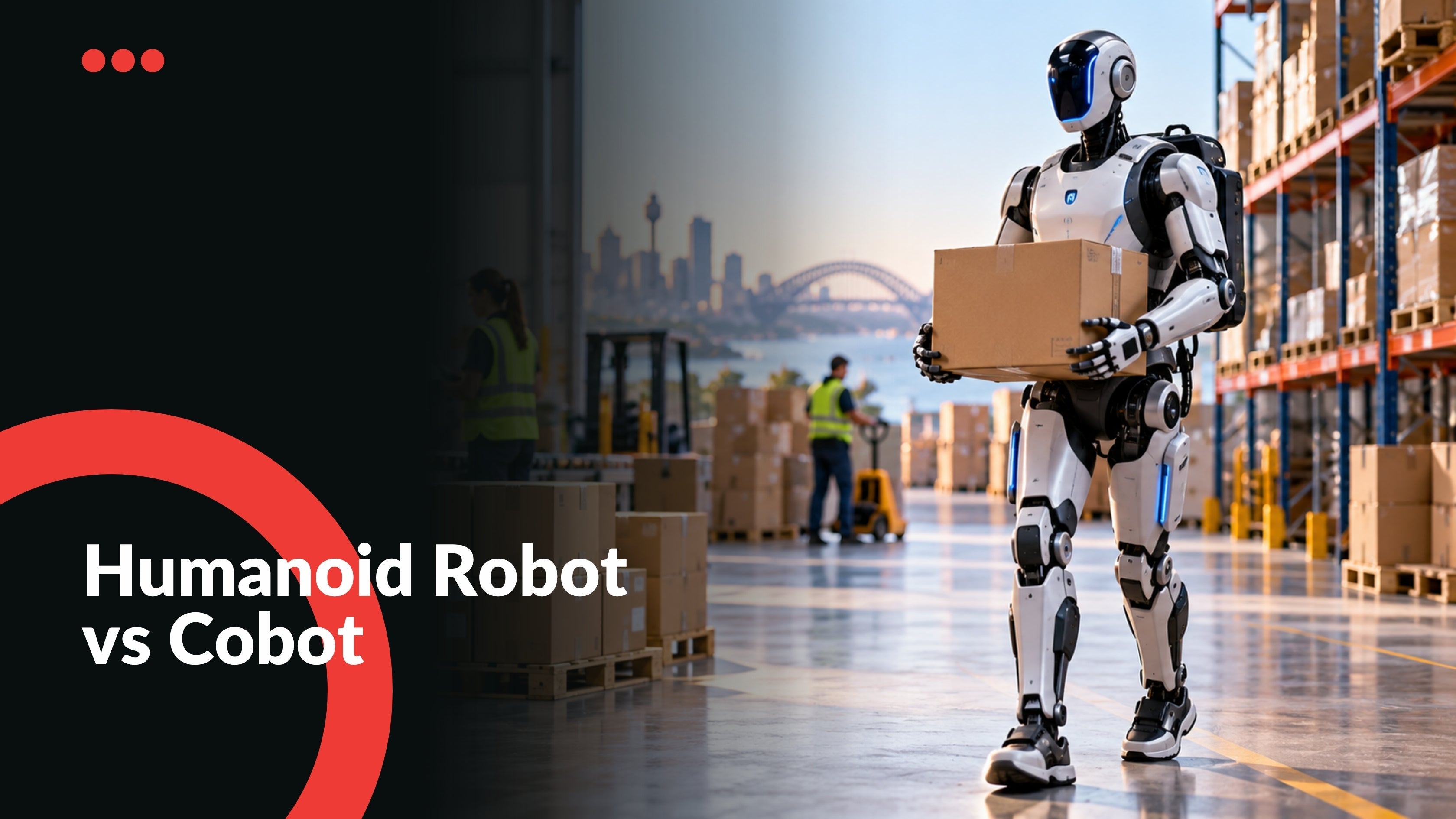
Business owners in Australia face a tough market right now. You deal with high labour costs and a serious shortage of workers. That brings up a big question about automation. When you start researching your options, you will quickly hit the big debate: humanoid robot vs cobot. Which one actually solves your problems?
Let's be real. You do not just want a metal arm that just seals cartons. You want an adaptable worker. In this guide, we will walk you through exactly what makes the two different. I will also explain why E-Ozzie is bringing the smartest automation solutions to the local market today.
The Core Difference Explained
First, we should define our terms clearly. A cobot (collaborative robot) is usually a mechanical arm fixed to a table or a track. They are built to work right next to human workers safely. You program them to do one repetitive task, like stacking boxes onto pallets, applying adhesives or sealants along paths, spray painting small parts, or labelling goods for shipment.
A humanoid robot is completely different. These robots are built in the shape of a human. They have a torso, arms, and usually legs or a mobile base. They do not just sit in one spot. They move through your warehouse or shop just like a human employee would. They can see their surroundings and make smart decisions on the go.
Overcoming Cobot Limitations in the Workplace
Cobots had their time in the spotlight. But as soon as business owners installed one, cobot limitations became hard to ignore.
-
Lack of Mobility: A cobot is bolted down. If you need work done on the other side of the warehouse, you have to move the whole setup or buy a second machine entirely.
-
Single-Task Focus: They do one thing well. If your business needs change tomorrow, you spend days reprogramming the machine or buying new attachments.
-
Workspace Redesign: Even though they are safe, you still have to build your workflow around their fixed position.
Frankly, for dynamic local setups, these restrictions hold you back. You need machines that adapt to your space, not the other way around.
Why Robots for Australian Businesses Must Adapt With Your Team
The market for robots for Australian businesses is shifting fast in 2026. Companies no longer want rigid assembly lines that take up half the warehouse floor. You need machines that move with your team. And this is exactly where robot automation for small business steps in to solve the problem.
Instead of redesigning your entire store or warehouse to fit a robot, you can bring in a humanoid that walks up stairs, opens standard doors, and uses the same tools your human staff use. They fill the exact gaps in your workforce without a million-dollar factory renovation. They are ready to work on day one.
Why Humanoids Are the Clear Winner for Modern Teams
The catch with automation is, if you buy a machine that only does one job, you will eventually need to buy ten more machines. Humanoids offer a better way. At E-Ozzie, we focus on humanoid technology because it is genuinely superior for everyday operations.
These machines can restock shelves in the morning, carry heavy boxes in the afternoon, and help with inventory checks at night.
They learn fast. Because they have human-like hands and arms, they interact with the world exactly as we do. This adaptability makes them a highly valued asset for any modern company. You get a real teammate, not just a programmable tool.
The Humanoid Robot Price Australia
Cost is always the elephant in the room. When you look up the humanoid robot price Australia, the initial number might seem higher than a basic mechanical arm. But you have to look at the massive return on investment.
You are not just buying a single-use tool. You are investing in a multi-purpose worker. The overall humanoid robot price drops significantly when you realise this one machine replaces the need for forklifts, conveyor belts, and multiple single-task cobots.
It is the smartest financial move for long-term growth. The value becomes obvious the moment they start handling three different jobs in one shift.
The Reality of Training and Maintenance
Another big factor is how easily you can train these machines. Older cobot arms are single-purpose tools bound to one station (a table, bench, or floor stand at a specific workstation). You often need an engineer to write new code every time the task changes slightly. That wastes time and money.
Humanoids feature mobile legs or bases, dual arms, AI spatial vision, and the ability to walk to different tasks. You can often teach them a new task simply by showing them how to do it. They observe the movement and replicate it. This saves you time. At E-Ozzie, we know that business owners do not have time to learn complex programming languages. You just need things to work.
Safety First: Working Alongside Smart Machines
Safety remains a massive priority for local managers. Cobots originally gained popularity because they are safe around people. They stop moving if they bump into a person.
Humanoids take this safety a step further. They use highly advanced cameras and spatial sensors. A humanoid does not wait to bump into you. It sees you walking down the aisle and adjusts its path in real time. It can read the room. This spatial awareness prevents accidents before they happen. Your staff can work right alongside them without feeling nervous or crowded.
Real-World Scenarios in 2026
Let's look at how this plays out on the floor. Imagine a busy retail stockroom. A shipment of fifty heavy boxes arrives at the back door.
If you use a cobot, you have to bring the boxes to the machine. The arm then sorts them onto a belt. Human workers still have to carry the items to the shelves.
If you use a humanoid, the robot walks to the loading dock. It picks up the boxes, carries them through the store, and physically places the items on the correct shelves. It handles the entire start-to-finish process. That is true automation.
Side-by-Side Comparison: Humanoids vs. Cobots
Take a quick look at how they stack up to make things easy.
|
Feature |
Humanoid Robots |
Traditional Cobots |
|
Mobility |
High. Can walk and navigate human spaces easily. |
Low. Fixed to a desk, floor, or track. |
|
Versatility |
High. Performs multiple different tasks efficiently. |
Low. Great at one specific repetitive task. |
|
Space Requirements |
Uses existing human pathways and standard aisles. |
Needs specific mounting space and safety zones. |
|
Tool Usage |
Uses standard human tools and manual equipment. |
Needs custom-built end-of-arm attachments. |
|
Adaptability |
Learns and adapts to new environments fast. |
Requires heavy reprogramming for new jobs. |
Why Choose E-Ozzie for Your Automation Needs
At E-Ozzie, we know what local companies actually need to survive and grow. We offer top-tier humanoid solutions alongside our electric mobility range because we believe in practical, forward-thinking technology. The demand for humanoid robots in Australia is surging right now.
We provide machines that actually make your daily operations easier. You get reliable support, solid hardware, and technology that grows with your brand. Do not settle for outdated tech that ties you down. Look into humanoids and see the difference for yourself.
Frequently Asked Questions
What is the main difference between a humanoid robot and a cobot?
The main difference comes down to shape and mobility. A cobot is a stationary robotic arm built to perform one repetitive task safely alongside humans on a fixed assembly line. A humanoid is shaped like a person with arms and a mobile base or legs. It can walk around your facility and perform multiple different tasks using the exact same human tools your team already uses. This physical design allows it to navigate stairs and narrow aisles easily.
Is the humanoid robot price justified for a small business?
Yes, absolutely. The humanoid robot price pays for itself quickly through massive versatility and low downtime. Instead of purchasing separate machines for packing, moving, sorting, and cleaning, one humanoid handles all these jobs across different shifts. You do not need to spend thousands redesigning your shop floor either. This makes it a highly cost-effective robot automation for small business that scale up as your company grows.
What are the biggest cobot limitations I should know about?
The main cobot limitations revolve around their lack of mobility and single-task design framework. You bolt them to a specific spot on the floor, and they stay exactly there. If your daily workflow changes, you must spend significant time and money retooling the arm and reprogramming the software for the new task. They also struggle to operate effectively if the physical layout of your workspace shifts unexpectedly.
Are humanoid robots in Australia safe to work alongside my staff?
Yes, they are highly safe and built specifically for collaborative environments. Modern humanoid robots in Australia use advanced optical sensors, lidar cameras, and responsive artificial intelligence to understand their immediate surroundings. They can detect human movement instantly. They stop or change direction if someone steps into their path, allowing them to work collaboratively without causing any safety hazards for your human staff.
How are robots for Australian businesses changing in 2026?
In 2026, robots for Australian businesses are rapidly moving away from fixed factory lines and caged operations. Companies want mobile, smart automation that fits directly into regular office, warehouse, or retail spaces. The current trend is heavily favouring humanoids because they adapt to existing environments without expensive structural renovations. Business owners want machines that solve multiple problems at once rather than doing just one thing.


Leave a comment